
Make New Friends, Play More Golf

If you’re trying to lower your golf handicap, consistent practice is essential. The problem is finding the time, access to a driving range, and cooperative weather. A round can take four hours, ranges close early, and winter months can undo all the progress you made over summer.
This is where a golf simulator becomes more than just a gadget.Used properly, it can be a powerful training tool that helps golfers practice year-round and improve their handicap faster.
At the driving range, you hit a ball, watch it fly, and then guess. Did you push it? Was that a path issue or a face angle problem? It is hard to say. A simulator removes that guesswork entirely.
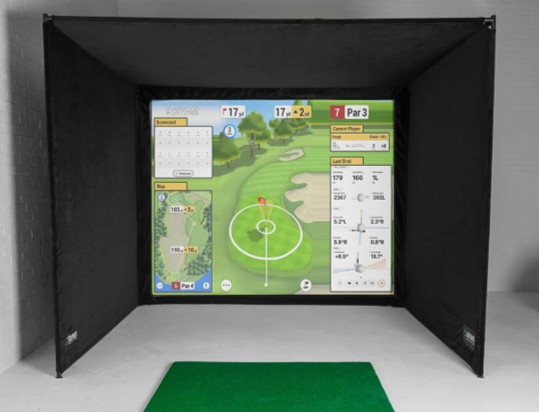
Every shot produces a full breakdown: clubhead speed, ball speed, launch angle, spin rate, club path, and face angle. That data tells you exactly what happened and why. Instead of spending 45 minutes reinforcing the same fault, you can spot it on shot three and start correcting it.
Professional golfers spend a lot of time practicing. Published research found that professional golfers can perform up to 300 swings in a single practice session and hit over 2,000 shots per week. That volume builds precision because every repetition comes with immediate feedback.
The same principle applies at the amateur level. The faster you close the gap between what your swing feels like and what it actually does, the faster your scores drop.
Consistency is where most recreational golfers fall short. Not because they lack effort, but because weather and life get in the way. A few missed weeks, and you feel like you’re starting from scratch.
This is where a quality home setup pays off. Golfbays builds golf simulator bays designed for exactly this purpose, so whether it is January or a rainy Wednesday night, you can get a focused session in without booking a tee time or leaving the house.
The benefit goes beyond convenience. Practicing 2-3 times per week produces better results than one long-range session, because your nervous system needs recovery time to consolidate new movement patterns between sessions. A simulator at home makes that kind of frequency realistic for people with normal schedules.
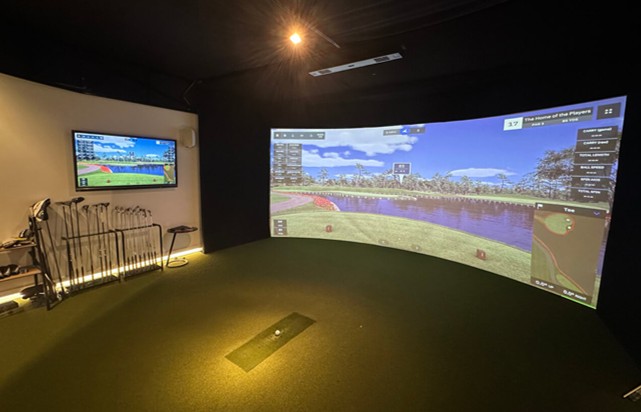
Most golfers default to hitting drivers at the range. It’s satisfying, and it keeps the weak spots comfortably out of view.
A simulator keeps you honest. Load up a course, play a full simulated round, and the numbers quickly show which parts of your game are actually costing you shots.
The data does not lie, and the evidence backs this up. An eight-week structured training study involving recreational golfers found that deliberate, targeted practice measurably improved swing mechanics, ball velocity, and carry distance.
Hitting your weaknesses on purpose, rather than avoiding them, is what moves the needle.
Here’s where most mid-to-high handicappers find the biggest gains:
Spending 20 minutes per session on wedges and short irons, rather than hitting the driver until your arms are sore will move your handicap faster than almost anything else you can do.
One thing a simulator can do that the range never will is put you on a golf course.
Playing virtual rounds on real layouts such as St Andrews, Pebble Beach, and Augusta teaches you to think like a golfer, not just swing like one.
You start making actual decisions: where to miss, when to lay up, and what the realistic percentage play is from different positions.
Over time, that decision-making becomes automatic. You arrive at a course you’ve never played, and the strategic instincts are already there.
It also connects directly to how your handicap is actually calculated. The Social Golfer’s Global Handicap System is built around your scoring performance across real rounds.
Which means every stroke saved through smarter on-course decisions shows up in your index.
Course management isn’t a soft skill; it’s directly measurable, and a simulator is one of the few places you can practice it without the cost of a round.
Practice Type | Shot Data | Multiple Courses | Short Game | All Weather |
Driving range | Limited | No | Some | No |
Golf course | None | Yes | Yes | No |
Golf simulator | Full | Yes | Yes (varies) | Yes |
Playing golf effectively depends on repetition. The right movement, repeated often enough, becomes automatic under pressure.
A simulator accelerates that process because you are not just hitting balls; you are hitting balls with feedback that tells you whether each repetition was effective.
The difference between block practice, which involves hitting the same shot repeatedly, and variable practice that simulates real course scenarios is well-documented.
Variable drills that change the shot requirement on each repetition transfer far better to on-course performance.
Much better than mindlessly working through a bucket, and a simulator provides both the structure and the data to make every session count.
Many golfers track their progress informally. If you’re actively working on improving, make sure you’re tracking your golf handicap consistently.
Without a baseline and regular updates, it is hard to measure whether any of this is actually working.
Yes, but only with intentional practice. Hitting balls for fun will not move the needle much. Using shot data to target specific weaknesses, practicing course management on virtual rounds, and staying consistent through the off-season all combine to create a genuine impact on your handicap over time.
Two to three sessions per week is the sweet spot for most recreational golfers. Short, focused sessions beat one long session per week, because your brain and muscles need time between sessions to consolidate what you’ve been working on.
Modern simulators are highly accurate on ball flight, launch data, and course layouts. They can’t fully replicate uneven lies, wind, or the specific mental pressure of a real round. The best approach is to use simulator time for technical work and actual rounds to apply what you’ve built.
Pick one goal per session. Choose a specific metric, such as club path, launch angle, or wedge carry distances, and work on that. Avoid the temptation to hit the driver for an hour. Work through your full bag, prioritize scoring clubs, and play simulated holes to practice shot selection.
No, and it shouldn’t try to. The simulator is a training environment. Use it to build skills, dial in your distances, and sharpen your course management, then take all of that onto the real course where it matters.
Overall, indoor home golf simulators vary widely in price depending on the technology and setup. A basic home setups can start around £1,100–£2,200, while mid-range systems typically cost £2,500–£5,000 and premium installations with advanced launch monitors and projection can exceed £10,000 or more.

Ian is the Editor of The Social Golfer. He has been reviewing golf courses for more than ten years. Ian was the Marketing Director of the London Golf Show from 2011-2016. He has had golf articles published in Golf News Magazine, Today’s Golfer and Golf Business News. Ian is also the Communications Director for The Cairns Cup (Golf’s Premier Disability Match Play Event).

The Social Golfer is a global online platform that helps golfers of all abilities:
TSG remains the most accessible platform for golfers to play more, travel more, and meet like-minded players.
For more information, visit www.thesocialgolfer.com
HEADER IMAGE - Mistwood GC
Courtesy of Raymond Hearn, Course Architect www.rhgd.com
__________________________________
Got a story you would like us to publish? Call us on 01277 200207
Alternatively, send us a message via our contact form... CONTACT US >>
FOLLOW US
© 2026 Built by www.mc2marketing.co.uk.
